
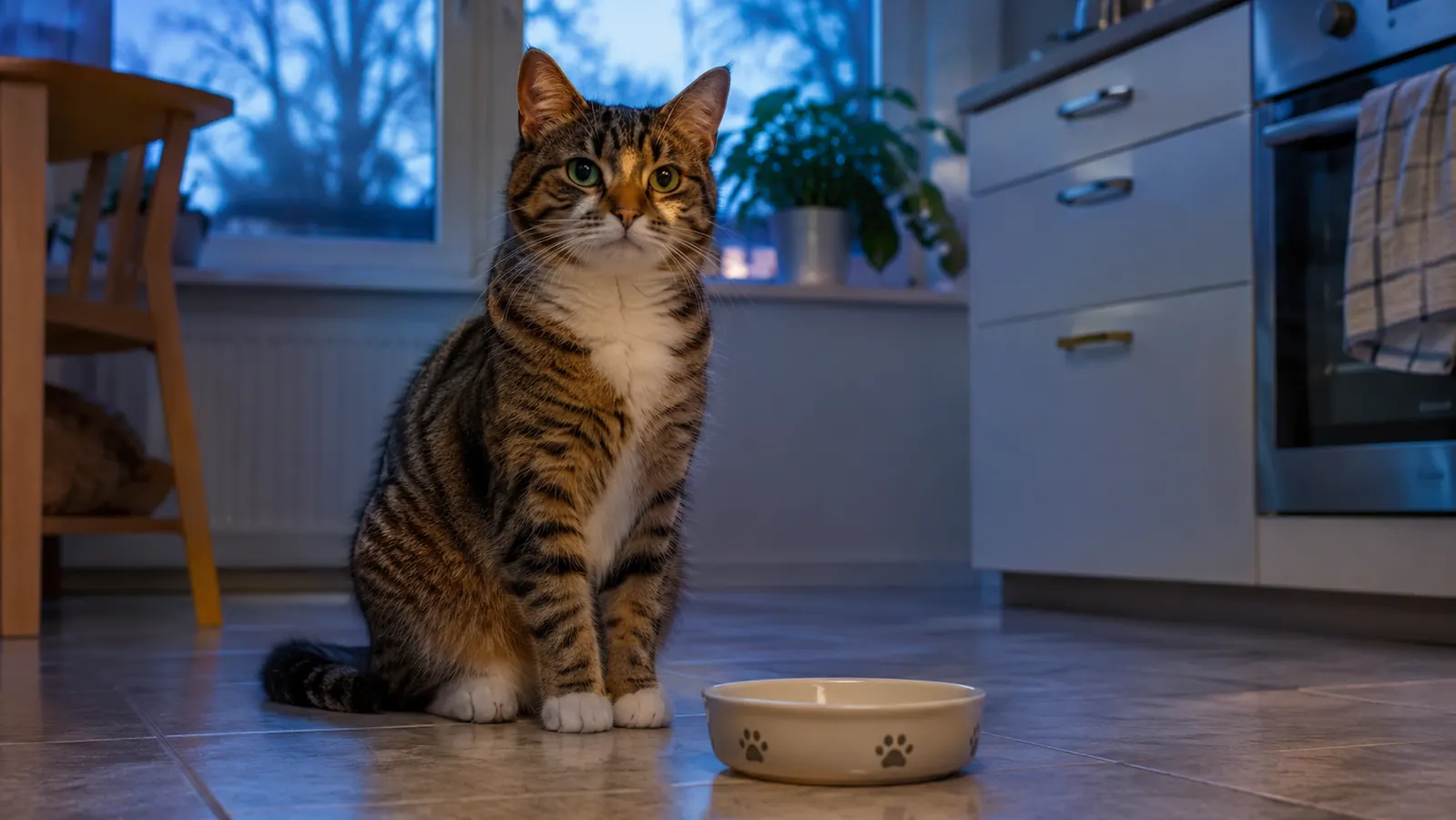
At 4:52 every morning, Juniper began the announcement. Not a meow exactly. More of a rising, gravelly complaint that started at the foot of the bed and worked its way down the hall, gaining volume with every step, until it hit the exact pitch that gets a person out of a warm bed in a Minnesota March. She is nine, a gray tabby, ten pounds, indoor only, and for the first nine years of her life she had never once been fed on a schedule. I fed her with a measuring cup, by hand, whenever she asked. She asked at 5.
Then the first week of March I started at the public library three days a week, and for the first time since I retired, the house went empty on a schedule. I bought the PETLIBRO automatic cat feeder with camera that same week, with my own money, and put it behind the pet gate in my home office. Her first scheduled meal is 6:30 A.M. The 5 A.M. yowling is gone. It did not go quietly, and it did not go because the machine did anything clever. It went because of the order I did things in, which is what this piece is about.
The whole change took an afternoon of setup and about two weeks of being unpopular. That is the honest timeline. Anyone who tells you the machine fixes the morning on day one has either a very flexible cat or a very short memory.
The machine that took over the 5 A.M. shift in this house
PETLIBRO automatic cat feeder with camera. Five liter hopper, 1080P camera with night vision, app scheduling, two-way audio. Dry food only, and it stays plugged in.
Amazon Check Today's Price on Amazon →Five Steps, In the Order That Made the Difference
Step 1: Pick the Spot Before You Unpack the Box
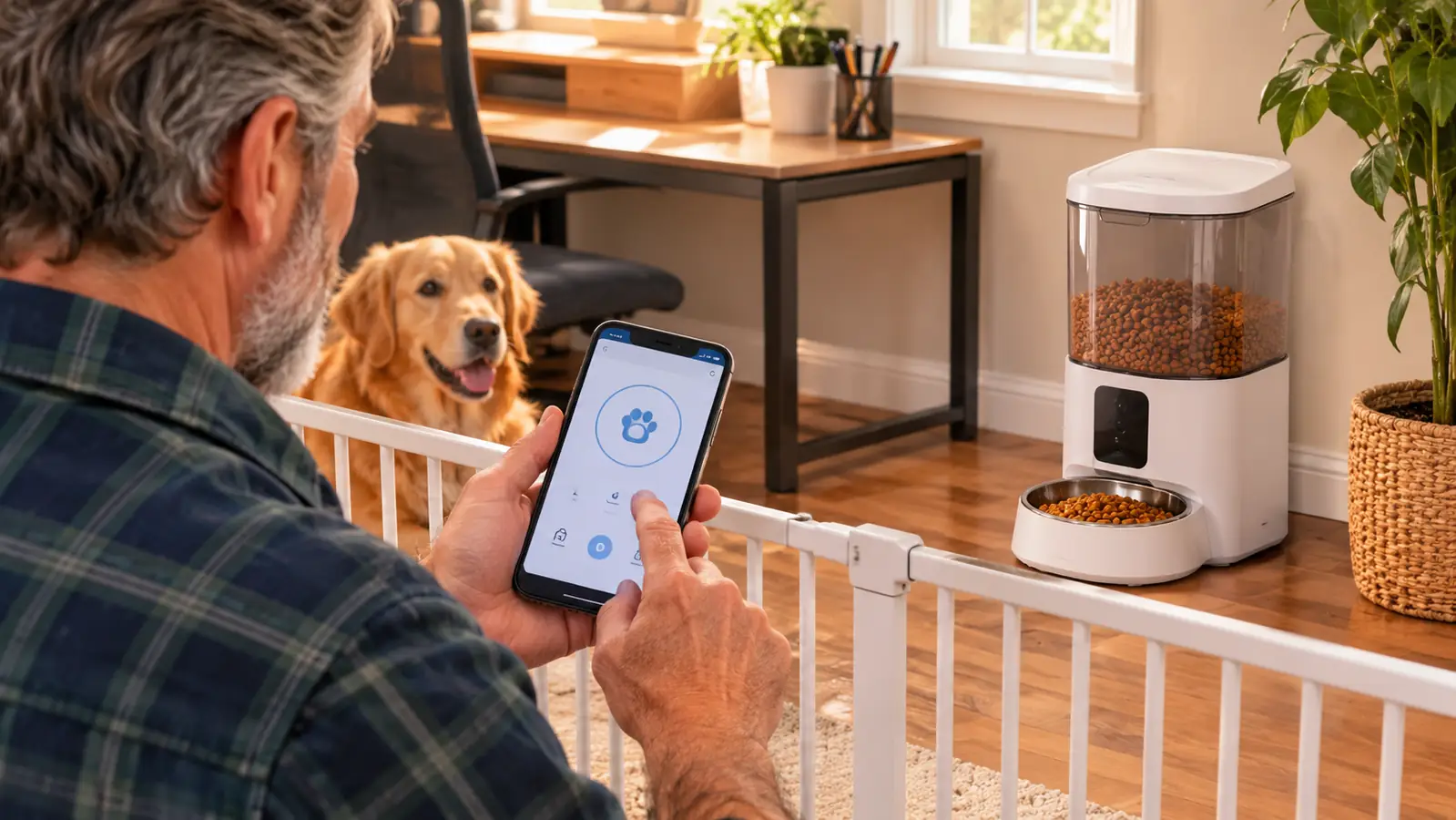
The feeder measures 13.78 by 12.99 by 7.48 inches and weighs 4.7 pounds empty. That is a real footprint on a kitchen floor, closer to a small appliance than to a bowl. Mine went on the floor of my home office, behind the pet gate, for one reason: Juniper fits through the small cat door in that gate and Biscuit, my beagle mix, does not. The cat eats from the machine. The dog does not, ever.
The second thing to check before you commit to a spot is power. It runs off the adapter that comes in the box, so you need an outlet within reach of the cord, not a shelf that happens to be near one. I spent twenty-six years watching people place network gear on a beautiful surface with no power anywhere close, and then act surprised. Do not be that person. Plug it in, listen to it run, then decide.
Third, think about sound. Not the machine's sound, yours. The entire point is that the feeder sits far enough from the bedroom that a cat parked beside it at 5 A.M. is not a cat parked beside your head. In a one story ranch that means a door and a hallway between you, not a corner of the room you sleep in.
One more: put it somewhere the bowl can be reached without moving the machine. You will be topping up a hopper and lifting a bowl out of a holder, and if either of those is a two handed operation in a tight corner, you will start skipping it, and a skipped top up is a missed meal.
Step 2: Get the App, Camera, and Wi-Fi Working Before the First Meal
Set the app and camera up a day ahead. Not the morning of. The PETLIBRO app handles the schedule and the portions, and the camera gives you a 1080P view with night vision. Our house runs on one 2.4GHz router, the same one carrying everything else, and pairing took a couple of minutes with the phone standing next to the machine.
Aim the camera at the bowl, then walk away and look at it on your phone. This is the step people skip. You want to know, before the first meal drops, exactly what you can and cannot see. Mine looks down at the bowl and a slice of office floor. That is plenty. The camera's job here is not security. Its job is answering one question at a glance: did she eat, and how much is left.
While you are in there, record the meal call if you want one. I did mine in my own voice. It works. It also means my voice now means food in a way I did not fully think through, and I am mildly haunted by how fast a cat can arrive out of a dead sleep.
Step 3: Match the Portions to What You Already Feed
The hopper holds five liters of dry food, and dry is the only thing it takes. This is the honest limit of the whole approach. If your cat eats wet food, this feeder cannot be the thing that solves your morning, and no amount of app work changes that.
Use the cup you already use. I had been feeding Juniper with a measuring cup for years, so I had a number to work from, and I divided that number across the meals rather than guessing at what the app calls a portion. Set the meals, set the portions, watch for two or three days, adjust once. The box includes a desiccant bag. Keep it in the hopper. Five liters of kibble sitting in a Minnesota kitchen will go soft otherwise, and a cat will notice before you do.
And here is the one that actually decides whether this works: stop feeding the cat by hand. Not reduce. Stop. An automatic feeder layered on top of hand feeding is not a schedule, it is a bonus, and Juniper can count.
Step 4: Move the First Meal in Small Increments
If your cat currently eats at 5 A.M., do not set the first scheduled meal for 6:30, go to bed feeling clever, and expect a quiet house. Move it fifteen minutes at a time, every three or four days, and let the cat's stomach catch up to the clock.
I will be straight about mine. I spent about a week pushing Juniper's breakfast later by hand before the feeder even went in, because I wanted the machine to arrive at a schedule she had half accepted rather than one she had never seen. You can skip that week. You will pay for it in yowling, which is the thing you were trying to fix.
Set the second meal too, and set it at a time you can actually keep. A feeder that feeds at 6:30 and again in the evening is a schedule. A feeder that feeds at 6:30 and then gets topped up by hand at 4 because somebody felt guilty is a cat with two jobs, and one of those jobs is training you.
Step 5: Hold the Line at 5 A.M., Then Stop Answering
For the first two weeks, Juniper still showed up at 5 A.M. and complained at a closed door. The feeder was not late. She was early, and being early had worked for nine years, so she kept trying it. That part is normal and it is not a sign the machine is wrong.
What you do at 5 A.M. is nothing. This is where the camera earns its place in the house. I could look at my phone, see whether the bowl from the night before was empty, confirm the feeder was fine, and go back to sleep without opening a door. That is the entire trick. You are not soothing the cat. You are collecting evidence that the cat is fine so that you can stay in bed.
The two-way audio is genuinely useful and I would still tell you not to use it before dawn. If a cat yowls and your voice comes out of the machine, the cat learns that yowling summons you. I use the microphone from the library at lunch, which is a different hour with a different lesson. By the end of the second week the 5 A.M. complaining had faded, and then one morning it simply did not happen.
The 5 A.M. yowling was gone by the end of the second week. Not quieter. Gone.
What This Feeder Won't Fix
It will not fix a bored cat, and 5 A.M. noise is sometimes boredom wearing a food shaped hat. It will not fix a house where two animals share one bowl, which is why the gate in my office is doing as much work as the electronics. It will not keep running with the plug pulled. It takes the power adapter, so a loose cord or a switched off outlet is a missed meal, and the camera will show you an empty bowl hours later when you check from work.
It is also not a vet. If a cat who has always been a good eater stops eating, or starts eating less and sleeping more, that is a call to Dr. Anand and not an app adjustment. A feeder tells you what happened. It does not tell you why.
And if your only goal is a cat who stops yelling, understand what you are actually buying: a machine that feeds on a clock, plus a camera that lets you verify it. The quiet mornings come from the clock plus your own refusal to get up. The camera just makes the refusal easier.

What Else Helps
Feed the dog somewhere else, by hand, on the dog's own schedule. In this house Biscuit eats in the kitchen, from a bowl, put down by me or by Neil, and he has never once eaten from the cat's machine. That separation is carrying a lot of weight. A cat with a private dining room behind a gate is a calmer cat, and a dog who cannot reach the cat's food is a dog who stops checking.
Keep water out of the argument. Juniper's water comes from the fountain in the kitchen corner, a different machine in a different room, so 5 A.M. is only ever about food and never about anything else. Then add whatever barrier your house already has. Mine is a pet gate. Yours might be a closed door, a hallway, or a fan running in the bedroom. Nobody is grading you on suffering.
Finally, give it the full two weeks before you decide it failed. The first four days are the loudest, and that is exactly the point where most people unplug the machine, fill the bowl by hand, and teach the cat that persistence works. If you are going to quit, quit during setup, not during the argument.
If your cat is currently the alarm clock, start with step one
Dry food, an outlet, and a spot far enough from the bedroom. The PETLIBRO camera feeder handles the clock, and the camera shows you what happened while you were asleep.
Amazon Check Today's Price on Amazon →