
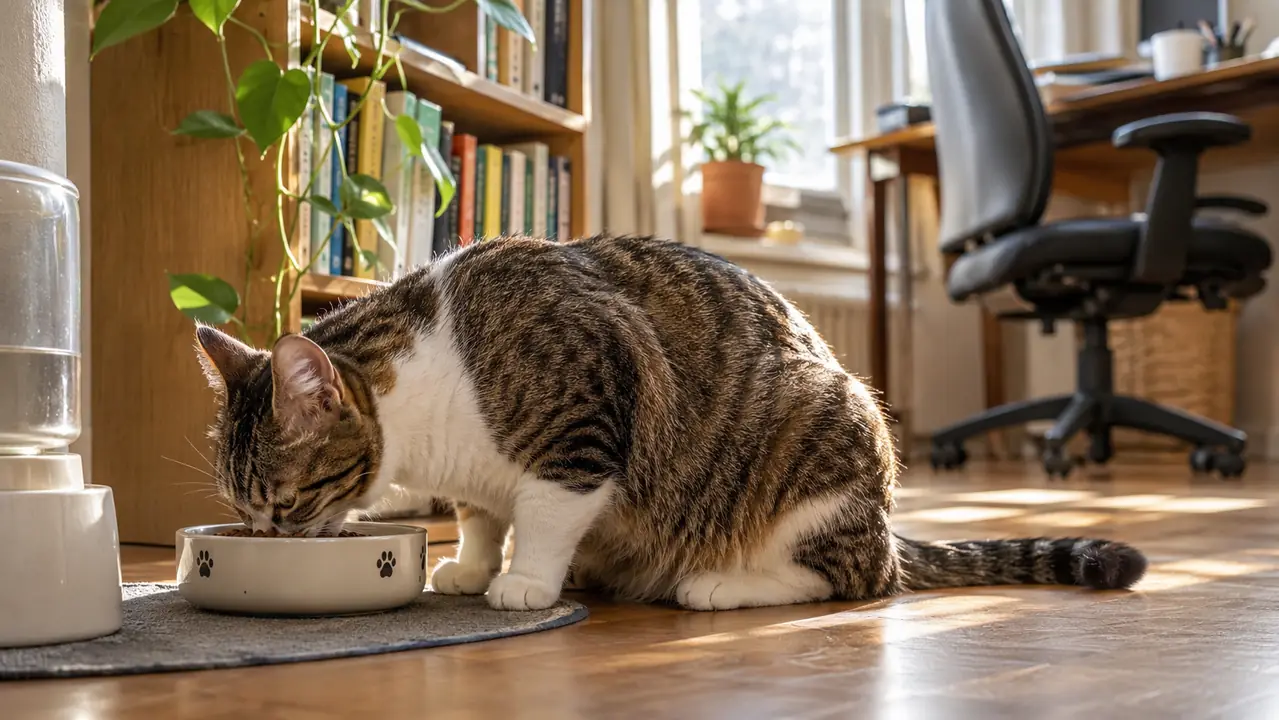
Juniper has yowled for breakfast at 5 AM since she was a kitten, and for eight of her nine years that was fine, because I was awake and I was home. Then in the first week of March I started a part time job at the public library in Duluth, three days a week, and the house went empty for the first time since Neil and I bought it. She did not take the schedule change quietly. Neither did Biscuit, our beagle mix, who plants himself at the front door and whines for a good twenty minutes after my car leaves the driveway. I spent twenty six years as a school district IT coordinator, so a new gadget does not scare me. What wears me out is a gadget that needs babysitting.
That is the mood I was in when I bought the PETLIBRO automatic cat feeder with the camera built into the front panel. I bought it with my own money in that same first week of March and set it up in my home office, behind the pet gate, for Juniper only. It has been running ever since, roughly eight months, through a Minnesota spring, a humid summer, and the start of a second winter. Long enough for the novelty to wear off and for the annoyances to settle into a list I trust more than my first impressions. Here is that list, along with the parts that quietly fixed something I had stopped expecting anyone to fix.
The Quick Verdict
A reliable scheduled feeder with a camera that genuinely earns its place. The app is the weakest link and the power cord is the catch, but the 5 AM yowling stopped in two weeks and stayed stopped.
Amazon Check Today's Price →The 5 AM Yowling Stopped in Two Weeks. Eight Months Later It Has Not Come Back.
The PETLIBRO camera feeder holds 5 liters of dry food, runs on a DC power supply, and lets you build a meal schedule and look in on your cat from your phone. It is the one piece of pet tech in my house that changed a behavior instead of just recording one.
Amazon Check Today's Price on Amazon →How I've Used It
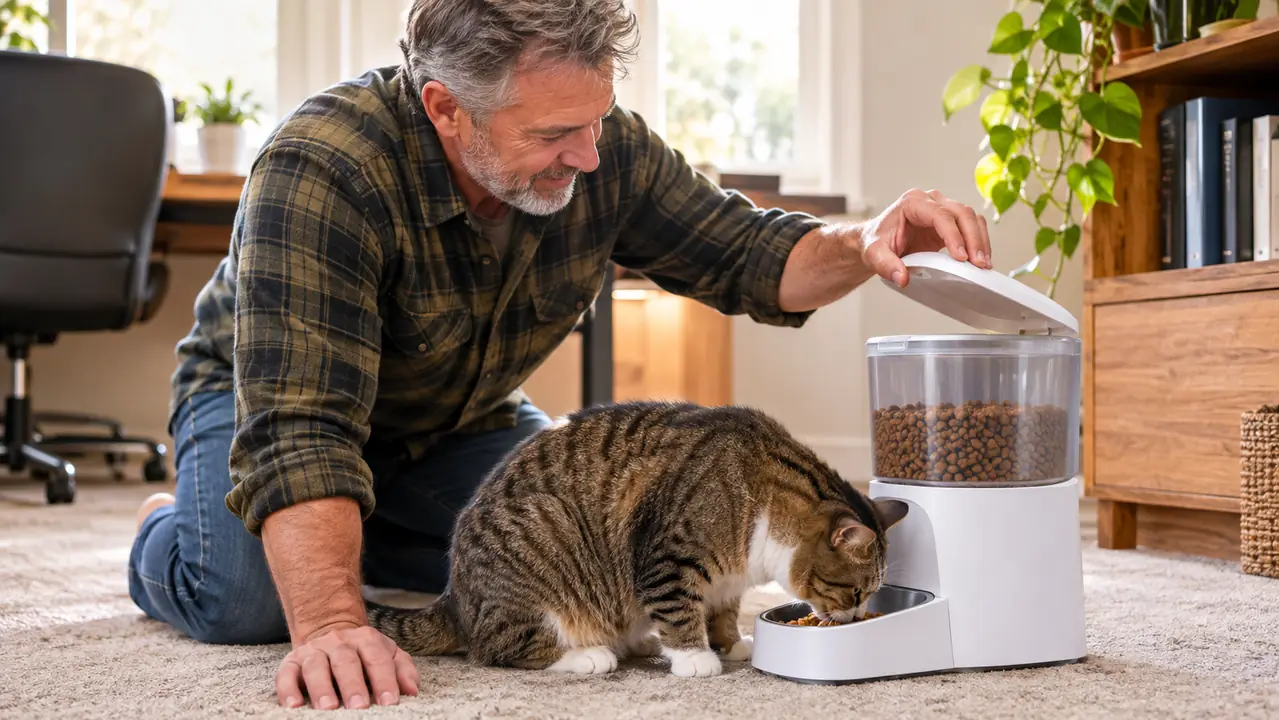
The feeder sits on the floor of my home office, which is the spare bedroom, behind the pet gate with the small cat door. Juniper can get through. Biscuit cannot, and that was the deciding factor in where it went. He is 31 pounds and food motivated, and a feeder he can reach is a feeder he will empty and then tip over for the pleasure of it. He gets fed by hand in the kitchen by me or by Neil, and he has never once eaten out of this machine. That is on purpose and it is not negotiable in this house.
Setup took me about twenty minutes, and ten of those were spent finding the desiccant bag in the box and reading the guide to see where it goes. The unit came with the feeder, the bowl and its holder, the power adapter, the user guide, and that desiccant bag, which sits in the hopper lid and keeps the kibble from going soft. It runs on a DC power supply, so it needs a wall outlet. There is no battery in this thing. That matters in Duluth in January, and I will come back to it.
The first morning did not go perfectly. I had built one meal in the app for 6:30 AM and then stood in the kitchen at 6:28 with my coffee, watching the office doorway like a woman waiting for a toast to pop. Juniper heard the kibble hit the bowl before I did. She came around the gate at a trot, ate, and then sat down and looked at the machine for a while, which is the closest thing to gratitude a cat offers. By day three she was waiting for it. By the end of the second week the 5 AM yowling was gone, and it has not come back.
Maintenance is a five minute job every few weeks. I pull the bowl and wash it in the sink, wipe out the hopper with a dry cloth, and swap the desiccant bag when it starts to feel soft. I do not take the whole unit apart and the guide does not ask me to. Eight months of that routine and the hopper still smells like kibble rather than anything worse, which is more than I expected given how much of my life has been spent cleaning things that promised to be low maintenance.
The 5 Liter Hopper, Measured in Weeks
The hopper holds 5 liters, and against one ten pound indoor cat that works out to a refill every three to four weeks. I fill it on a Sunday, write the date on the calendar, and forget about it. The whole unit measures 13.78 by 12.99 by 7.48 inches and weighs 4.7 pounds, which means it sits sturdily on the floor but is not so heavy that I grumble when I move it to vacuum underneath. It fits in the corner between the bookcase and the wall without blocking the outlet.
Dry food only, and that is not a limitation I mind, because Juniper is on dry food and the wet food is a Saturday treat I hand her myself. The bowl is wide and shallow enough that her whiskers clear the sides, which sounds like a fussy detail until you have owned a cat who refuses a deep bowl and eats off the floor instead. The hopper lid seals with the desiccant inside it. In August, which is humid here, the kibble at the bottom of the hopper was still crisp when I refilled it. That is the sort of thing I notice now that I am not spending my days resetting other people's access points.
What the Camera Actually Shows You
The PETLIBRO camera is 1080P HD with night vision and a 145 degree view, and it is the reason I paid attention to this model instead of buying a plain feeder. I check in from the library on my lunch break, on my phone, and I can see the office floor, the bowl, and a couple of feet of rug beyond it. Juniper is usually asleep in the patch of sun by the window at noon and completely unbothered by being observed. That is the entire appeal. I am not watching for entertainment. I am watching to confirm that a nine year old cat who has never lived alone is eating while I am not there.
The night vision earns its keep from November through February, when 6:30 AM in Duluth is still full dark. The frame is grainy in that mode, the way any of these cameras are, but I can tell the difference between a full bowl and an empty one, and I can tell whether the cat is at it. Two-way audio is built in, and there is a meal call you can record in your own voice. I recorded one. Juniper ignores it completely, which is her right, and I have stopped taking it personally.
Where the camera has genuinely helped is the ordinary paranoia of a first winter of leaving. In March I was checking four or five times a day. By June I was checking once, at lunch. Now I look in maybe twice a week, usually when I am already thinking about her. That tapering off is the best review I can give any monitoring device. A camera that makes you look less over time is a camera that is doing its job.
The App, From Someone Who Fixes Bad Software for a Living
I spent twenty six years cleaning up other people's software rollouts, so I am harder on an app than most people would be. The PETLIBRO app is where you build the meal schedule and where the camera feed lives. It connects over Wi-Fi, and our single router runs 2.4GHz, so pairing went through on the first serious attempt. My first attempt was not serious. I was holding the phone at arm's length and jabbing at the screen instead of reading what it asked for, which is the same mistake I watched teachers make for two and a half decades.
The app itself is serviceable, not lovely. The schedule screen makes sense once you have used it twice. Remote feeding works, and I have used it exactly once, on a Thursday in April when I got held up at the library and texted Neil to say I would be late. I opened the app from the parking lot, sent her meal, and watched her eat it on the camera before I started the car. That is a small thing. It also meant nobody had to drive home in the middle of a shift, and on a day when the lake effect was doing its worst, that counted for a lot.
My complaints are the ordinary ones. The icons are small. The app occasionally takes a few seconds to hand over the live feed, and when it does, it does not always tell you why. Updates arrive without much explanation. None of this stopped me from feeding my cat. All of this is why the average rating on this thing sits where it does instead of higher, and having read a fair number of those reviews, I think most of the frustration is aimed at the software rather than the machine.
The Parts That Annoy Me
The power cord is my real complaint. The feeder runs on a DC power supply, so a wall outlet is the whole story, and when the power blinks in a storm the meal does not happen. We lost power for about four hours in a July storm and Juniper got her breakfast late, by hand, from me, at 8:40. That is a fine fallback when I am home. It is not a fallback when I am at the library. If you travel a lot or live somewhere with unreliable power, this is the detail to weigh before anything else on this page.
Second annoyance: the camera tells you what happened but not why. If the kibble stops dropping, you will see an empty bowl and a puzzled cat and no message explaining either. I had one near miss, in a humid week in August, and I caught it because I happened to look. That is a general truth about these machines rather than a flaw specific to this brand, but it is worth saying plainly rather than burying under a paragraph about how convenient everything is.
Third: it is not a small object. It is a 4.7 pound box roughly 14 inches across sitting on the floor of a bedroom, and if your kitchen is tight you will notice it every single day. Mine lives in the office, so I do not care. If you are picturing this in a galley kitchen next to a fridge, measure first and save yourself the return shipping.
What I Liked
- A 5 liter hopper means a refill about every three to four weeks with one cat
- 1080P camera with night vision and a 145 degree view covers the bowl and the floor around it
- Two-way audio and a recordable meal call, if your cat cares about that sort of thing
- Scheduling and remote feeding both work, which sounds like a low bar until you have owned a feeder that fails it
- Kibble stayed crisp through a humid Minnesota August thanks to the desiccant bag in the lid
- Eight months in, no missed scheduled meal except the one caused by a power outage
Where It Falls Short
- Runs on a DC power supply, so a power cut means no meal until you get home
- The app is functional but plain, and the live feed can take a few seconds to load
- No alert when the hopper stops dispensing, so you have to look
- Big footprint for a single cat household
- The average rating sits at 4.1 across roughly twelve thousand reviews, and the complaints cluster around the software
The 5 AM yowling was gone by the end of the second week, and eight months later it has not come back.
Who This Is For
This is for someone with one cat on dry food, who leaves the house on a schedule and wants both a meal and a look at the bowl while they are gone. It suits a house where the feeder can live out of reach of a dog, and it suits a person who will actually read the setup guide and whose Wi-Fi reaches the room they have picked. It has suited me, and it has done the specific job I bought it for, which was to stop a nine year old tabby from starting her day at 5 AM and to let me stop wondering about her at noon.
Who Should Skip It
Skip it if you need it to keep working through a power outage, because it will not. Skip it if your cat eats wet food, since this is a dry food machine through and through. Skip it if the only place it can go is somewhere a determined dog can reach, unless you are prepared to manage that with a gate rather than a wish. And skip it if you want an app that feels finished, because this one is useful and plain in equal measure. None of that makes it a bad purchase. It makes it the wrong purchase for a different house than mine.
Eight Months, One Power Outage, and a Cat Who Now Sleeps Until Six
The PETLIBRO camera feeder did what I bought it for: a 6:30 AM meal, a camera I can check from my lunch break, and no more 5 AM concerts. If your house empties three days a week like mine does, it is worth a look at today's price.
Amazon Check Today's Price on Amazon →