
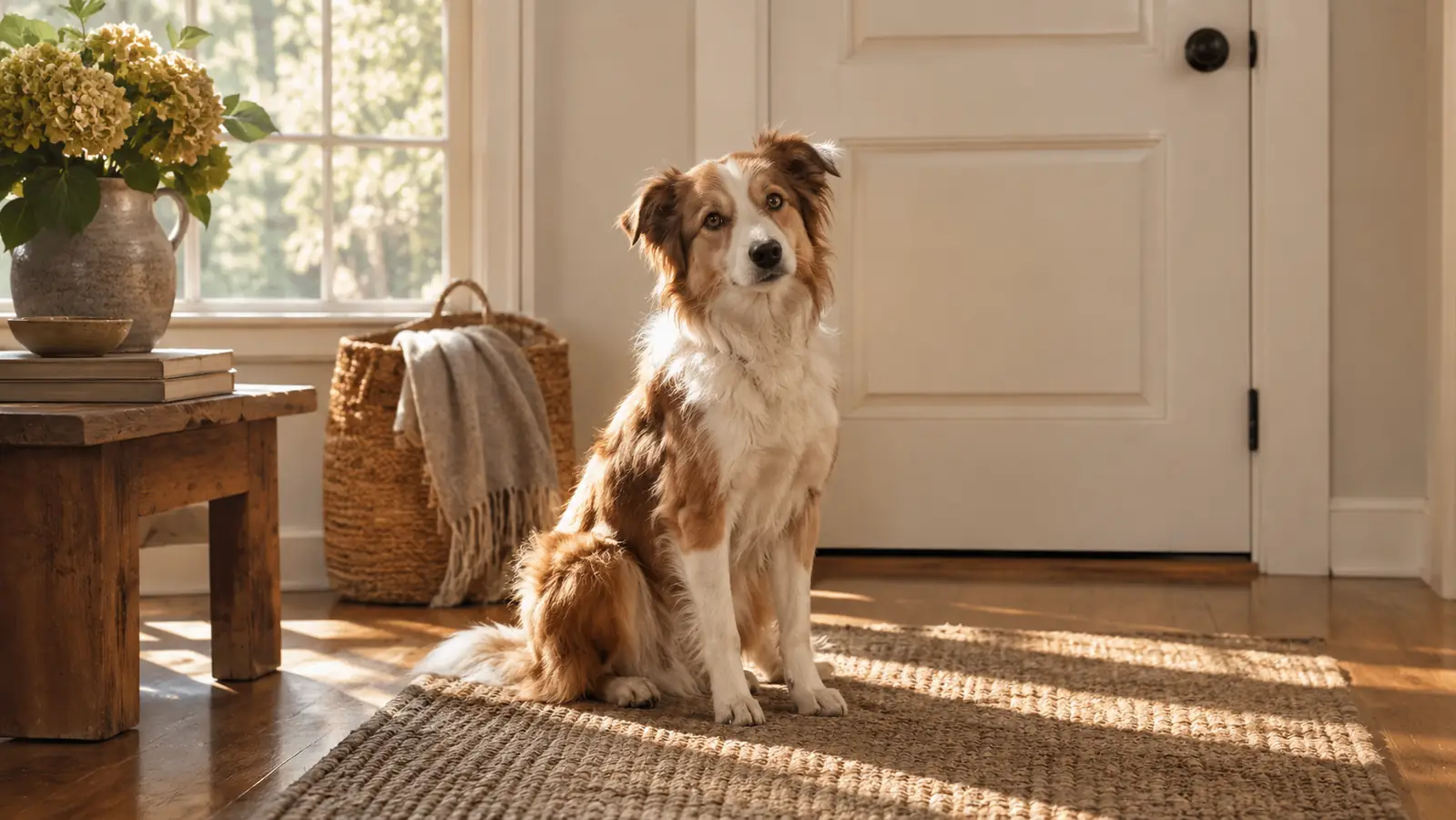
The first Tuesday I came home from the library, Biscuit had worked himself into a state. Wet nose prints on the front window, a raw spot where his paw had worried the door frame, and that high thin whine he does that is not quite a bark. I had started a part time job three days a week and, for the first time in four years, the house was going empty on a schedule. He did not take it well.
I am not a trainer and I am not a vet. What I am is a woman who spent twenty six years fixing other people's Wi-Fi, which means I read the manual, I notice when an app is badly built, and I will tell you the truth about both. This is the routine I built that first week in March, with the Furbo 360 Dog Camera on a low side table facing the front door. It took about six weeks. It did not cure anything. It did help, measurably, and I can show you the numbers.
The camera I set up before I built the rest of the plan
The Furbo 360 is the piece of this that let me see what was actually happening after I shut the door, instead of guessing from the state of the window. It needs an active plan to do anything, which I pay yearly. Read the listing carefully before you decide.
Amazon Check Today's Price on Amazon →What You Actually Need Before Step One
Before any of the steps below, be honest with yourself about one thing. A camera does not reduce your dog's anxiety. A camera lets you see the anxiety, react in real time, and stop yourself from making it worse by coming home early every time. That is the whole job. If you want something that fixes the dog while you sit at your desk, this is not that, and a subscription based gadget is an expensive way to learn it.
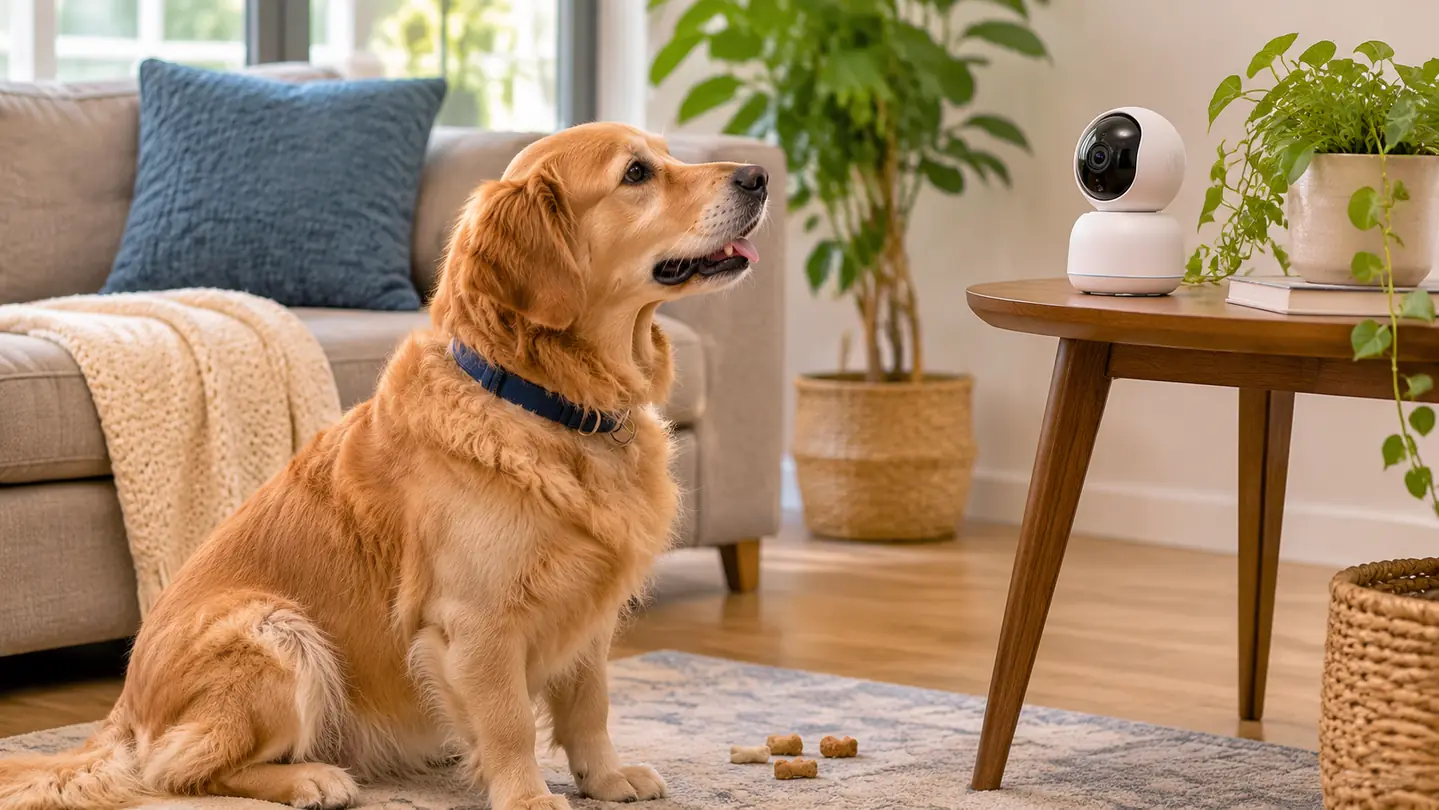
I also want to be clear about the Furbo itself. It is a dome shaped camera on a cord, rated at 10 watts, running on 5 volts direct current, with 360 degree rotation and a full 1080 HD live view. It has two way audio, color night vision, and it tosses treats. It connects wirelessly over your home network and you run it from an iOS or Android phone. It is not a trainer. It is a window and a hand.
Step 1: Get the Camera Watching the Door Itself
I put mine on the low side table in the living room, angled so the front door and the shoe mat were both in frame. Not the couch, not the middle of the room. The door. Whatever your dog fixates on when you leave is the thing you need to see, and for Biscuit that was the door and the window beside it.
Set it up when you are home and calm, on a day you are not going anywhere. The camera runs on a cord to the wall, so pick a spot near an outlet and stop moving it. Every time you relocate it, you relearn the room, and you lose days. Mine sits about eight feet back from the door and roughly three feet off the floor, which is high enough to catch his whole body and low enough to see his face when he lies down. The cord reached the outlet behind the table without an extension cord, and truthfully that decided the placement for me.
One thing I paid for and did not expect to use: the AI alerts. Barking notifications, unusual activity, that sort of thing. The first week they were far too chatty and I nearly turned them off in a fit of pique. Instead I went into the app and tuned them down. Do that in week one rather than letting your phone buzz all through a work morning, because a notification you have learned to ignore is worse than no notification at all.
Step 2: Record Three Departures Before You Change Anything
This is the step almost everyone skips, and it is the one that made the difference for me. Before I changed a single thing about how I left, I recorded three ordinary departures. Same morning routine, same time, same everything. Just me, my bag, the door, and the camera watching. I did mine on a Monday, a Wednesday and a Thursday, the three days I am actually gone, and I used the same bag and the same coat every time so nothing about the morning was different.
Then I sat in my car in the driveway and watched the live view on my phone for twenty minutes. Biscuit whined for roughly the whole of it, paced a circuit from the door to the window and back, and settled only when he wore himself out. I had assumed he was fine after five minutes. I was wrong for four years.
You need a baseline because otherwise you are guessing about progress, and guessing is how people talk themselves into buying three discontinued gadgets and a thunder shirt. Write it down. Time he starts, time he stops, what he does in between. Three recordings, one notebook page. Mine was four lines in a spiral notebook clipped to the cover: start, stop, pacing, no damage. I still have it.
Step 3: Make Leaving and Coming Back Dull as Dishwater
This is the least fun step and the most important one. Dogs who panic at the door have usually learned that departures are A Big Deal. Keys, shoes, the coat, the goodbye voice, the sympathetic look. All of it is a signal, and all of it raises the temperature in the room before you have even touched the handle.
So I made it boring. I picked up my keys at random times on a Saturday and put them down again. I put my shoes on to go get the mail. I stopped saying goodbye. I stopped the whole farewell performance, no petting, no long look, no reassurances, because reassuring a panicking dog tells him there was something to be scared of. I picked up my keys eleven separate times on one Saturday in March. Neil asked me twice what I was doing. By the tenth time Biscuit had stopped lifting his head off the rug.
First departures after that were absurdly short. Out the door, into the car, watch the phone, come back after four minutes if he was quiet. Then seven. Then fifteen. The Furbo was how I knew whether to come back, and the two way audio was how I said nothing at all instead of talking to him through the door, which I had been doing and which I now know was making it worse.
Step 4: Use the Treat Toss Properly, Not as a Bribe
The treat toss is the feature people buy the Furbo for, and it is easy to use badly. If you toss a treat every time your dog whines, you have built a vending machine with a whining button. I did that for about four days before I worked out what I was doing.
What worked was tossing during the calm stretches. If I checked in on my lunch break and Biscuit was lying down with his chin on the rug, that earned a treat. If he was mid whine, he got nothing from me, and I closed the app. It took a while for that to land. It did land, somewhere around week four. The first two weeks I also got it wrong in the other direction, tossing a treat the second I opened the app because it felt like doing something useful. That is a habit, not a plan.
A practical note. Get the treat size right before you leave the house for real, because a large biscuit will bounce off the floor and roll under furniture and a tiny one will vanish. I tested from the next room while I was home. The app itself is fine on my iPhone, though the video takes a beat to wake up when you first open it, which is normal for a camera on a home network rather than a fault.
Biscuit's whining after I left ran about twenty minutes in March. By about week six it was down to a few minutes. That is the entire result, and I will take it.
Step 5: Build a Longer Absence Slowly, and Stop Rewarding Panic
Once the short departures were calm, I stretched them. Fifteen minutes, then thirty, then the length of an actual library shift. I kept the camera watching the door the whole time and checked in on my lunch break rather than every ten minutes, because there is a difference between monitoring and hovering and the hovering was making me worse, not him.
The bar for stretching the time is quiet, not happy. If your dog is lying at the door with his ears up but not whining, that counts. If he is pacing and crying, you went too long and you go back a step. This is not a competition and there is no schedule to keep.
By about week six I could go a full shift and come home to a dog who was awake and pleased to see me but not frantic. The window nose prints stopped. The door frame healed. It was not linear. There were two bad weeks in April when the routine slipped, and the whining came back for a few days. Work got hectic for both of us, I let the morning walk slide, and by the second week the whining was back to eleven or twelve minutes. I reset to short departures and it settled again.
What Else Helps
The camera is a tool, not a treatment. A few other things helped in combination, and none of them came from a gadget. Leaving a worn t-shirt on the rug near the door helped more than I expected. A morning walk before I left took the edge off, so Biscuit was tired rather than coiled. And keeping the departure time consistent, rather than drifting twenty minutes either way, made the whole routine easier for him to read.
What did not help: a loud radio, which he ignored, and a stuffed toy, which he unpacked in about nine minutes and then whined at. Your mileage will vary. If your dog is hurting himself, if he is destroying doors or windows, or if the panic has been going on for months, this is a conversation for your vet, not a camera. I did mention it to Dr. Anand in passing and left it there, because a gadget review is not a diagnosis.
I also want to say plainly what the Furbo does not do well. The subscription is not optional, and if you skip it you have a dome on a table that does nothing. The AI alerts on barking were too eager until I tuned them. It is corded, so there is no carrying it to the yard. And the treat hopper needs a refill every so often rather than once a season. It earns its place in my house. It is not the camera for everyone.
Eight months in, I still check in on my lunch break on Tuesdays, Wednesdays and Thursdays. Usually Biscuit is asleep. Sometimes I toss a treat for no reason at all except that I can, and that is worth a good deal to me on a gray Duluth morning.
If your dog is whining at the door, this is where I would start
The Furbo 360 is the piece that let me finally see the twenty minutes I had been guessing about for four years. It needs an active plan to run, and it will not fix the dog on its own. It gave me the information, and the routine did the rest.
Amazon See the Furbo 360 on Amazon →