
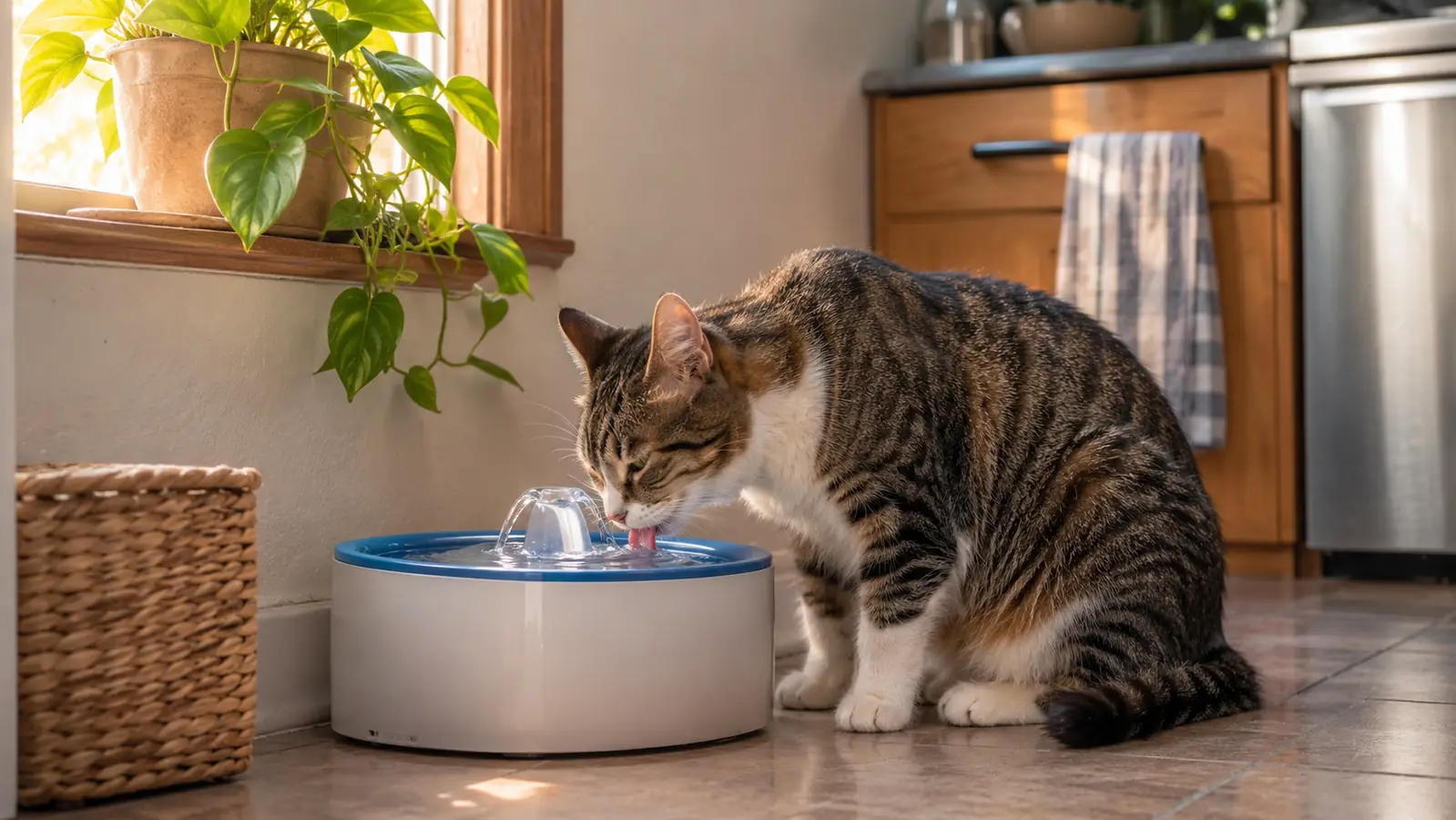
The first thing I did after unboxing the PETKIT Eversweet Solo SE was put my ear next to it. I spent twenty six years as a school district IT coordinator, which means I have listened to a lot of equipment make noises it should not make, and I have learned to listen before I trust anything with a motor in it. The fountain hummed. I stood in the kitchen for a full minute and decided that was acceptable.
I bought it myself in the first week of March, the same week I started part time at the public library in Duluth. That is when our house started sitting empty three days a week for the first time in decades. Juniper, our nine year old gray tabby, is particular about water. Biscuit, the beagle mix, is particular about food and almost nothing else. The cat is the customer here. Eight months in, my honest read is that the PETKIT fountain is well built and genuinely quiet, and that it carries two annoyances and one hard limit the listing does not lead with. You should know all three before you spend anything.
The Quick Verdict
Quiet enough to forget it is running, and the wireless pump makes the weekly wash far less fiddly than older fountains. But the unit still needs a wall outlet, and 1.85 liters goes fast when a cat and a dog share it.
Amazon Check Today's Price →The quiet part is real. So is the cord.
If noise is why the last fountain ended up in the basement, this is the one I would hand you. Before you order, walk your kitchen and find the outlet you can actually live with.
Amazon See the PETKIT Solo SE on Amazon →How I've Used It
The fountain sits on the kitchen floor in the corner, on the same tile where a plain ceramic bowl used to live. It has been there since that first week in March. Juniper and Biscuit share it. Nobody else in the house drinks from it, though Neil has threatened to.
I measured the run from the outlet behind the counter to that corner with a length of string before I bought anything. Twenty six years of running cable through school buildings will do that to a person. It came out to about five feet of slack along the baseboard, which was enough. If the string had come up short I would have put the fountain in a worse spot and resented it every time I filled it.
Setup took about ten minutes, and most of that was rinsing the filter. You plug the USB cable into an adapter and the wall, set the top section on the base, fill it, and the water starts moving. There is no app, no account, no Wi-Fi pairing, no firmware update, nothing to log back into when it forgets who you are. After a career of walking people through device pairing over the phone, I want to be clear about how much I enjoyed that part.
Before this we had a plain ceramic bowl in that corner, going back years. I tried a bowl in the hallway first, back in February, and that lasted about a week. Biscuit knocked it over twice and the tile stayed wet. I also tried a raised stand, which Juniper ignored completely. What finally pushed me toward a fountain was watching her drink from the bathroom tap while I brushed my teeth. She was telling me something and I was slow to hear it.
Juniper inspected the new fountain the first evening and walked away, which is her review of most things. By day three she was drinking from it without checking over her shoulder first. Eight months in she uses it several times a day, and the ceramic bowl is in the basement behind the holiday boxes.
Biscuit treats it as a second water bowl that happens to hum. He is a 31 pound beagle mix with his nose permanently on loan to the neighborhood, and he drinks from it after walks. That sharing matters for two reasons I will come back to: capacity, and how often the thing needs washing.

What the Listing Says, and What That Means at Home
The real numbers, since they matter more than the adjectives. Capacity is 1.85 liters, which is 65 ounces. The body is 7 by 7 by 7 inches and weighs 2.23 pounds empty. The material is ABS plastic. It ships with a pump, a filter, and a USB cable, and it carries a one year manufacturer warranty. Seven inches square is small enough that I can lift it with one hand and set it on the counter without clearing space first. That sounds like a small thing until you have owned a fountain you had to unplug and carry with both arms.
The pump is the interesting part. It is a wireless pump, meaning the pump unit itself sits in the water with no cord running through the basin to reach it. The fountain still plugs into the wall for power. I want to be precise about that, because wireless pump and cordless fountain get used interchangeably online and they are not the same thing. You still need an outlet. What changes is that nothing electrical has to be threaded through plastic every time you lift the lid, and that turns out to matter more than I expected.
It also ships with a filter, and the listing names it as the filter 3.0 version, which the company says increases the amount of filtration. I change mine about monthly. More on that below, because the filter is the quiet recurring cost of fountain ownership.
There is an indicator light that reports working status and warns you when the fountain is out of water. Mine has lit up twice, both times on a hot week when I had let the level drop. It is not subtle, which is exactly the right design choice for a warning light.
The Noise Question
The listing claims the pump 3.0 reduces noise to 25 dB. I have no meter and no lab, so I cannot verify a figure like that, and you should treat any single decibel number with one raised eyebrow. What I can tell you is what my kitchen actually sounds like.
At a normal water level, from two rooms away, I cannot hear it. Standing at the counter with the dishwasher off, it is a low steady trickle, quieter than the refrigerator compressor that kicks on every twenty minutes. I stopped noticing it inside a week, and I am a person who notices.
There is one evening I remember. Neil had a game on in the living room in April and I walked out to the kitchen for a glass of water and realized the fountain had been running for hours without me registering it from the couch, maybe twenty feet away with a doorway between us. That is the test I actually care about, and it passed.
The sound does change as the water drops. A low fountain runs a touch louder and slightly gurgly. That is not a defect, it is how moving water works, and it doubles as a useful reminder to top it off.
The one noise that is not fine is the rough, throaty sound the pump makes when the intake gets fouled with hair or debris. That shows up within a day of it starting. It is your cue to take the pump out and rinse it. I learned that the boring way, by ignoring it for a week and then wondering why my quiet fountain had opinions.
What Nobody Tells You
First, 1.85 liters is not as much as it sounds once a cat and a dog are both drinking from it. With Juniper and Biscuit sharing, I top it off every other day and do a full dump and rinse twice a week. If you have two large dogs, this is not the fountain for you, and no amount of quiet will fix that.
Second, this is a small appliance and small appliances need washing. Weekly, in my house. The ABS basin develops a faint slick on the walls faster than a ceramic bowl does, and once you have noticed it you cannot unsee it. The wireless pump makes this much easier, because I lift the pump out, rinse it, and set it aside without wrestling a wet cord past a plastic lip. That is the real argument for the design, not the marketing copy.
Third, the filter is a consumable. It is not a large expense, but it is not nothing either, and it is the kind of recurring cost people forget when they compare a fountain against a bowl. I replace mine about once a month and I keep a note on the fridge, because otherwise I would realize in June that it was still the March filter.
Fourth, and this is the one I would most want a friend to tell me: a fountain is not a medical device and it is not a fix. Juniper drinks more than she used to, and for a cat that is generally good news, since cats are famously bad at drinking enough. But if you are worried about kidney function or urinary trouble, that is a conversation with your vet. Dr. Anand has my deep respect and has never once asked me what kind of fountain we own.
The wireless pump is not a marketing detail. It is the difference between washing the thing in ninety seconds and finding reasons not to.
What I Liked
- Genuinely quiet at a normal water level, quiet enough that I stopped hearing it within a week
- Wireless pump comes out in one piece, so the weekly wash takes minutes instead of a wrestling match
- No app, no account, no Wi-Fi pairing, nothing to update
- The indicator light actually warns you when the basin runs dry
- Small footprint at 7 inches square, so it fits a kitchen corner without taking over
- One year manufacturer warranty
Where It Falls Short
- It still needs a wall outlet, so placement is limited by where the cord reaches
- 1.85 liters goes fast with a cat and a dog sharing
- The filter is a recurring cost you have to remember
- The ABS basin needs a genuine weekly wash to stay pleasant
- Not enough capacity for two or more large dogs
- Quiet depends on water level, so a low basin is noticeably louder
The Weekly Wash, Honestly
My routine takes about ten minutes and I do it on Saturday mornings. Unplug the cable. Lift the top section off. Lift the pump out and set it in the sink. Dump the basin. Wipe the walls with a cloth and a drop of dish soap, rinse well, dry. Reassemble, fill, plug back in.
The pump intake is where the hair collects. Ours catches a surprising amount of it, given that Juniper is short haired and Biscuit is not allowed near the fountain with a full coat of yard on him. I rinse the intake under the tap and pick out what the water leaves behind. If I skip that step, the sound changes within a day and I know why.
The first attempt took twenty minutes because I was being fussy with the pump. Now it is routine. The part I appreciate is that nothing is tethered inside the water, so I am not holding a full basin at an angle while trying to keep a cable out of the sink. If you have ever cleaned an older fountain with a wired pump, you know exactly what I am describing.
I do want to be honest about the friction that remains. Ten minutes on a Saturday is not nothing. It is a chore you did not have with a bowl. What you get in return is moving, filtered water that both animals actually drink from, and my cat drinks more now than she did from a static bowl. Whether that trade is worth ten minutes a week is a judgment only you can make, and I would not pretend it is free.

Where It Falls Short
The cord. I keep coming back to it because placement is the one thing you cannot undo after you buy. My fountain is in the kitchen corner and the nearest outlet is behind the counter, so the cable runs along the baseboard. It is tidy enough. But I could not put this fountain in the hallway where Juniper spends her afternoons, because there is no outlet there. A bowl goes anywhere. This does not.
Capacity is the second real limit. Two animals, one modest basin. I would rather top off a small fountain every other day than haul a larger one to the sink once a week, so for me the trade works out. If you would rather do less frequent maintenance on a bigger reservoir, this is the wrong shape of product for your house.
And the honest third: it did not change our mornings the way people hope. Juniper still yowls at 5 AM. She yowls for breakfast, not for water, and no fountain on earth solves that. The machine that solved it for us was a scheduled feeder, which is a different purchase entirely.
Who This Is For
One cat, or a cat plus a small dog, in a home with an outlet you can reach without running a cable across a doorway. Someone who wants the fountain quiet enough to live in a kitchen without noticing it, and who wants the water moving so a picky animal drinks more than she would from a bowl. Our house is one story, one router, and one outlet within reach of that corner, and that is the shape of home this fountain wants.
It is also for the person who does not want another app in their life. There is nothing to pair and nothing to update. I spent twenty six years managing devices that needed attention. This one needs water and an occasional rinse, and that is the entire relationship.
Who Should Skip It
Skip it if you have two or more large dogs. The capacity is not there and you will be refilling constantly. Skip it if the only workable spot in your house has no outlet within reach of the cable, because the cord is not optional no matter how much the phrase wireless pump makes you hope otherwise. Skip it if you know in your heart that you will not wash it, because the plastic will tell on you in about ten days.
And skip it if you want something that talks to your phone and reports how much your cat drank. This fountain does not do that and does not pretend to. It moves water, it lights up when the basin is empty, and it stays quiet. That is the whole feature list, and for a lot of households that is exactly enough.
Eight Months In
The fountain is still on the kitchen floor. Still quiet. Still getting washed on Saturdays. Juniper drinks from it more than she ever drank from a bowl, which was the entire point of buying it. Biscuit uses it after walks. I have been through most of a box of filters and topped the basin off more times than I could count.
Would I buy it again? Yes, with the same caveat I would give a neighbor: find your outlet first. The PETKIT Eversweet Solo SE is a small, quiet, well built fountain, and the pump design makes maintenance genuinely easier than the fountains I have cleaned for other people. It is not perfect. The cord is a leash, the reservoir is modest, and the filter is a bill you will pay again. Knowing all of that, I would still put it in the same corner.
Measure the cord run in your kitchen before you order
Nine out of ten complaints about a fountain like this come down to placement and capacity, not quality. Check the outlet, check the basin size against how many animals are drinking, then decide.
Amazon Check availability on Amazon →